
Last week I was guest host of the Carnival of the Mobilists, a weekly collection of interesting mobile-related posts from all over the web. Along with the Carnival, I ran a little survey on its readers. Some of the results surprised me.
The poll results below are fun, but not scientific. All they tell us is the opinions of Mobilist readers who like to fill out surveys; we don't know what the rest of the readership thinks. On the other hand, about 25% of the readers filled out the survey, so that's a pretty good sample. Here's what we learned:
Our most popular services: Text, browsing, e-mail. Other than making voice calls, our most popular usages of mobile devices are, in order: texting, browsing the web, and email. But we hate downloading ringtones and photo messaging.
So much for convergence. Almost all of us carry more than one mobile device on a regular basis.
Majority European. About 55% of us are from Europe, with 21% from the UK alone. 34% are from the US. The Carnival is generally a Euro-American thing, with some Canadians and Australians spicing up the mix. I was disappointed that we have very few readers from India, Japan, southern Europe, and all of Asia other than Australia.
We are Nokia bigots. We lust after Nokia far more than any other brand of mobile device, followed distantly by Apple and SonyEricsson. There were big variations by region, though.
We're generally satisfied with the Carnival. Most of us are very happy with the Carnival. That's not too surprising – anyone who hated it would probably stop reading it, huh? But there were also a number of good suggestions, which I'll list below.
The details
Good turnout. We had 115 responses, which is about a quarter of the people who dropped by to read the Carnival that week. That's a very good response rate for this sort of survey. Thanks very much to everyone who responded!
Demographics: we're running a Euro-American stag party. We are 80-85% males, across all regions. The readership is also overwhelmingly European and American, with very few visitors from other places that do a lot of blogging in English, such as India. There are also very few readers from the southern European countries -- Italy, France, Spain, etc. Here's where the readers come from: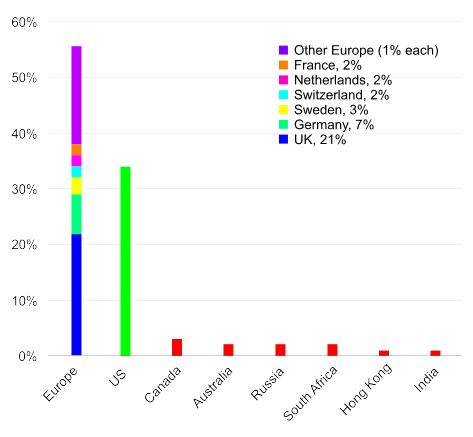
But we're not all the same age. The Americans among us are, on average, older than the Europeans. I don't know what to think of that.
(Unless otherwise noted, the color scheme for all the charts is: green=US; blue=Europe; and red=rest of world. If you are color-blind, the order is, from left to right: US, Europe, rest of world.)
Age of Carnival readers: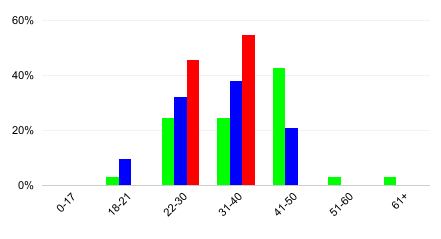
We also asked about occuptaions. There were too many different occupations to cut the results by country, but overall the largest job category was mobile software company. If you add the top four categories – mobile software company, web company, operator, and consultant – they accounted for about 50% of the total.
What type of company readers work for: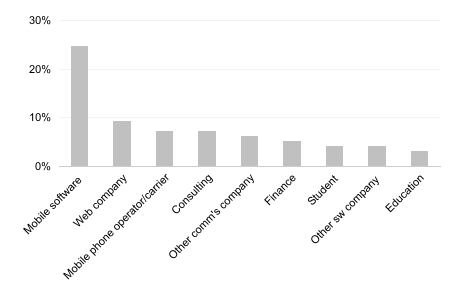
It's often said that blog authors communicate only to other blog authors. That's half true for the Carnival – about half of us have our own blogs, with the highest percentage of bloggers being in Europe.
Percent of readers having a...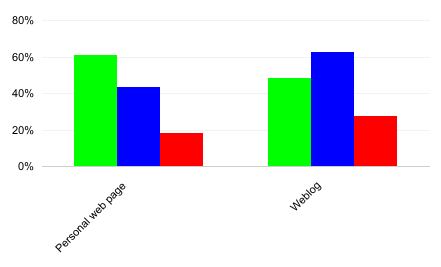
To converge or not to converge? Not. I'm sure to take some flak for my interpretation of this one, but I think it's fascinating that most of us carry more than one mobile device on a regular basis. The most popular mobile device is the laptop everywhere except Europe, where the smartphone is the narrow winner.
Percent of readers carrying a particular type of device on a regular basis: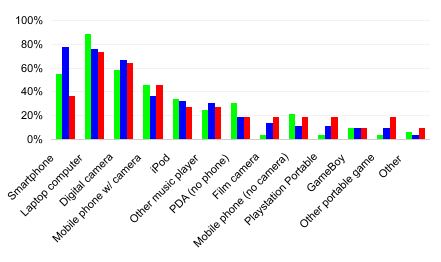
So at this point, even among the elite Mobilist readership, the smartphone is not heavily replacing the laptop for most of us. More surprising to me, the smartphone isn't at this point replacing a lot of other things either. Even if you exclude the laptop, 86% of smartphone owners carry at least one other mobile device on a regular basis.
Here are the other devices carried by smartphone owners:
More than 60% of the smartphone owners also carry a digital camera. About 60% carry an iPod or other music player. About 30% carry a game player of some sort, and 25% carry a cameraphone in addition to their smartphone.
I know there are strong advocates of convergence among the Mobilist base, and maybe it'll happen in the future. But we haven't converged yet.
By the way, 3G penetration is higher in Europe than in the rest of the world. Here's the percent of us with 3G:
What do you do with your mobile device (other than voice calls)? Short answer: a lot. The chart below shows the percent of us who use a feature more than once a day:
There were significant variations by region. In Europe (blue), texting is by far the king. In the US (green), the champs are e-mail and browsing. In the rest of world (red), games spiked quite a bit (although the sample is so small that I'm reluctant to draw any conclusions about that).
I was intrigued by the low scores for MMS, maps, and video – those are supposed to be three of the hottest growth areas for mobile data. So I took a different look at the data, comparing the percent of us who use a feature very frequently to the percent using it very infrequently. That lets you see which features are not used at all, versus which ones are used sometimes.
So, for example, about 30% of us use e-mail on our mobiles more than once a day, while about 25% almost never use it. The rest of us are somewhere in-between: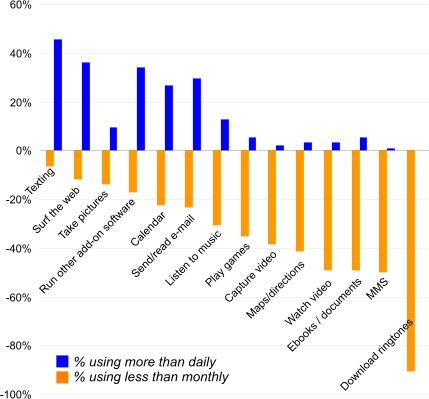
By this measure, we all hate downloading ringtones, which is very ironic since they're one of the most popular features among phone users as a whole. We also do very little picture messaging, e-book reading, and video watching. From the chart, it looks as if taking videos scored a little better, but 20% of us said our phones can't capture video. That doesn't show up in this chart, but if it did, the usage of video capture would be very low.
Which brands make us drool? Nokia. I was surprised by this one. Nokia inspired far, far more product lust than any other mobile brand we tested. I expected them to do well, but not this well. There were important differences by region, though – Nokia was less dominant in the US, and Palm was relatively weak in Europe.
I was shocked at the low scores we gave to RIM and Motorola. There are in this world Razr and Blackberry fanatics, but we haven't managed to include them in our readership.
This chart shows the percent of us giving a brand a seven or eight on a 1-8 scale, with eight being most lustworthy:
To understand the numbers better, I made a chart comparing the highest and lowest scores. The upper bar shows the percent of us giving a brand a score of 7 or 8 (the top of the scale), while the lower bar shows the percent of us who are very indifferent to a brand (a score of 1 or 2, or had no opinion of the brand at all):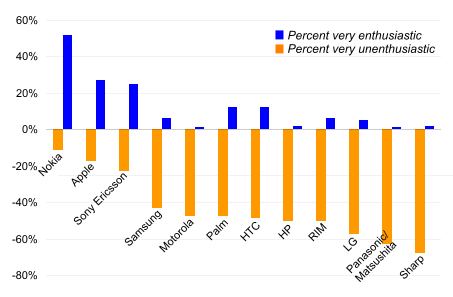
So Nokia is extremely strong, and Apple and SonyEricsson are also doing quite well (less than 20% of us were indifferent to them). Palm and HTC both had significant numbers of very enthusiastic people, although their share of indifferent people was pretty high.
I'm disappointed by the poor score we gave Sharp. Over the years, they have consistently created some of the most fascinating mobile devices. Unfortunately, most of them never make it out of Japan. And since we have virtually no Japanese readers, most of us are unaware of what Sharp's doing.
Monthly phone bill: All over the map. Usually when you ask a question like this, there's a definite curve – the responses tend to cluster in one part of the chart and then taper at either extreme. The striking thing about this chart is that there's almost no curve at all. Our phone costs are all over the map. Fifteen percent of us in Europe have monthly phone bills over $200 a month. Is this what happens when the operators don't offer flat rate data plans?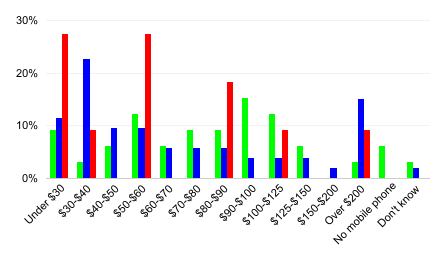
Satisfied with the Carnival. Most of us are satisfied with the Carnival, although that's to be expected since people who hate it would stop reading.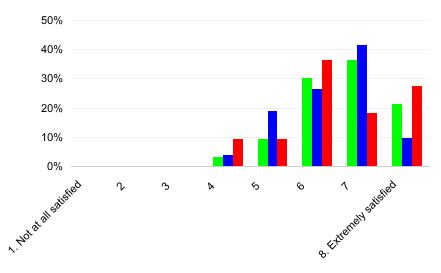
In this case, I think the written comments are more interesting than the numbers. Here they are, with groupings and a few editorial asides from me...
Happy people
Love it - great reads. I must admit I do skip some articles and only read the ones that appeal to me each week. I hope to be able to contribute later this year.
Keep up the brilliant work.
Good job everybody!
It's very good as it is.
Just keep going and keep a good balance between visionary items, technical & practical observations, entertainment stuff, usability and mobile lifestyle.
It seems quite good as it is.
Suggested features
Possibly more "Get the most out of (Insert mobile device with recently released software here) Guides"?
More information about the mobile internet - current status and future predictions.
A killer feature would be some sort of searchable catalog of past carnivals, with inclusion of their sub-links of course. [Cool! How about a meta-index of all the past Carnivals, kind of like the yearly indexes that some magazines produce? –Mike]
More photos. A forum for commentary on each article of the carnival. Creating a dialog between readers will allow more views and solutions to our wild jungle of an industry.
I find many of the articles are marketing based, this is no doubt an important area of discussion but not one which interests me much. The most interesting articles for me are those concerning everyday users and ways to make your device work best for you.
It would be cool to see how people have customised their mobiles within the community - each week have a new phone that has the best personalisation more stories about how mobile is used by the youth and generally more stories about how the people in the community use their mobile daily - my mobile day
I would like to see more articles on the mobile space in Africa, specifically South Africa where the mobile space is as advanced as any in the world, bar the far east. Certainly more advanced than the USA. Mobile technology is having a profound effect in the lives of many Africans. It is in fact helping a lot of countries bridge the technological devide.
Please more technical content. More critical. Tell me what you like/hate.
I noticed that there are only few articles in the Carnival that cover topics like PIM or alike. This is what many Smartphone-users heavily rely on...
General feedback
My original understanding was that Carnival hosts were obliged to publish every submission they received. I don't think there are a lot of low-quality posts, but there have been a few that hosts have included apparently believing that they had no say in the matter. I know this is in the host FAQ but could we clarify it somehow? [Good point, and I think we should have a discussion about this. It does vary by host. Some seem to be selective about what they link to, others (like me) link to every article that comes in during a week. My philosophy is that I don't know what info you need, so I'll let you decide. But I give much more prominent placement to the posts that I like best. –Mike]
I think the Carnival happens too frequently, which in turn lowers the quality of the writing. Most contributors are regulars and it's difficult to come up with something original every week. If I wanted to read from the same author each week, I'd probably follow his/her blog instead. I suggest to do the Carnival once per month or introduce some other measure to reduce the amount of articles/higher their quality. Maybe let the readers vote for the Top 5 articles per month.
Great summary of what is written on blogs. I would appreciate - moderated discussion as soon as carnival is released to be able to ask some questions to the authors - more insight about user experience for new services. [I like the intent behind this one, but I have a feeling that most Carnival participants would not want to move discussion of their posts off of their own blogs. Maybe I'm wrong, though. –Mike]
Often very wide range of participants. Sometimes I would have liked some focus.
Original content is what I'm looking for. There are a million aggregators but few producing thought provoking content.
Results of this survey. more questions about info or discussions, maybe some reader suggested ones.
Formatting/tone
More humour!
The themes are cute but get in the way of fast reading and comprehension. I'd also like to see a survey of posts rather than a description of submitted posts ... a little less self-promotion. Perhaps bloggers can submit their sites for weekly consideration?
Some of the authors seem to regularly write about things that are not mobile related, what's with that? Some of the Carnival hosts are too rambling, it can be hard to find the meat.
Maybe make the presentation a bit less geeky/weirdo. The first time i heard about the carnival (via a link on AAS home page), i went to the carnival's page, saw weird carnival pictures (nothing on the page that would give a hint that it was all about mobile devices) and loads of text with plenty links and inside jokes and no explanation really of what this was all about. Since i didn't have much time, I just closed the window since I couldn't quickly figure out what was happening here and the presentation just didn't appeal to me at all. It's only a few weeks later that i tried it again. This time I took the time to follow the link and eventually understood what it was all about. I'm now a regular reader but, frankly, if you wanted to do your best to scare newbies away, you couldn't do better. That said, now that i know what the carnival is, the presentation is fine to me. It's just that my first impression was one of confusion and "why the hell did AAS link to this weird thing?". Apart from that, the carnival really is a brilliant idea and it's always a joy to discover the new links every week. There's always loads of interesting things to read on various topic so keep up the good work.
[Ouch! I'm one of the guilty parties on this one. Bloggers tend to be kind of showoffs, and it's very tempting to try to find the ultimate Carnival photo or come up with a cute new Carnival-related theme. But I can see how that would be intimidating to a new reader. When I host in the future I'll try to make my write-up more accessible to newbies. Hey, how about we come up with a standard couple of lines explaining what the carnival is? Each host could put that near the top of their edition of the Carnival, to make sure new readers would know what they're seeing... –Mike]
Want more information on the survey results? Come to this address and you can analyze them for yourself.
_______
PS: Thanks to the folks at MobHappy for including my post on smartphones vs. PCs in the latest Carnival.
Who reads Carnival of the Mobilists?

Will the smartphone kill the PC?
The quotes coming out of London this week had me wondering: Is Symbian's management insane? Or are they just posturing?
Here's what they said:
"The personal computer as we know it will soon be dead, replaced by rapidly growing demand for smart mobile devices, according to the head of Symbian." --IT Pro
"Mobile phone access will be the next significant Internet phenomenon." --Symbian press release
"In five years' time you'll wonder why you need a PC at all." --John Forsyth, Symbian's Head of Market Propositions (a title that apparently means something very different in the UK than it would in the US)
They sound disturbingly like some of the most enthusiastic PDA enthusiasts did in 2000. I cringed then, and I cringe now. Here's why:
A PC, at its heart, is about information creation. The keyboard, mouse or trackpad, large screen, and large memory are all there because they're needed to manipulate words and images and numbers – spreadsheets, written documents, presentations, graphics, and databases. Despite all the hoopla about browsing and games and e-mail, creating and editing information is still the core use of the PC. That's why efforts to produce smaller or cheaper PCs with fewer features have all been failures -- take out the core productivity tools, and people won't buy the product.
Mobile devices are built around a different type of usage. They're all about information and communication access while you're on the go. They deliberately compromise information creation in order to get more mobility. So they're wonderful for voice communication, nice for simple texting, and adequate for short e-mail. But every effort to use them for heavy-duty information creation has been a miserable failure.
For a smartphones to replace PCs, they would have to take on all the features of a PC -- they'd need to input and edit text as easily as a PC, create spreadsheets as easily as a PC, edit pictures and presentations as easily as a PC, and manage large databases as easily as a PC. To do that in a small mobile device, you need a color folding screen (so you can work with large documents), either a full-size keyboard or perfect voice recognition, a pointing device a heck of a lot more sophisticated than a five-way rocker, enormous amounts of storage, and a fast processor.
Oh, and you need an operating system that doesn't break its installed base of apps every time it moves to a new version.
The color folding screen is in development, sort of, but many years away. Voice recognition is getting better on PCs, but it requires a ton of processing power and memory. I like the RIM Pearl trackball, so that might work out OK for the pointing device. But the processor requirement is a killer – a fast processor means lots of power, and battery capacity is simply not up to it today. Maybe it'll happen when we get fuel cells small enough for mobiles, sometime around the end of the decade.
I think when you add up all the uncertainties, it'll be another six years at least before you see a fully functional PC replacement as small as a mobile phone (in other words, it's beyond any realistic product planning horizon today). By that time, something the size of a PC will be even more powerful, and people may well trade up to that. But even if they don't, a mobile device with all that power and feature set could easily run Microsoft Windows itself, so why does Symbian think it's going to take over? More likely Microsoft will displace Symbian, since all the most popular productivity apps already run on Windows.
No, the realistic scenario is that PCs and smartphones (and other mobile devices to come) will prosper in parallel for years, each doing its own thing increasingly well. There will be some overlap at the edges, but the core usage of each product will remain very distinct. Meanwhile, the web apps platform will continue to gradually eat away at both operating systems, transforming them into commoditized plumbing that few people care about.
I'm not sure which OS will withstand web apps commoditization longer. Windows is more vulnerable to displacement by web apps because so many PCs have reliable high-speed web access. Symbian is somewhat protected because high-speed wireless is costly and eats even more battery power, and besides the operators are interfering with the deployment of web apps in the mobile space. On the other hand, Symbian has a lot fewer loyal applications developers than Windows, and in fact the lack of Symbian apps at the recent Symbian conference was noted by some observers. A smaller applications base means less resistance to commoditization, because there are fewer apps to replace.
Overall, if I were at either Symbian or Microsoft right now, I wouldn't be bragging too much about the inevitable forces of history. Never send to know for whom the bell tolls, Symbian...
SaaS vs. Web 2.0
Here's something I wrote for the Rubicon Consulting weblog. I thought it might be of interest to folks here.
Web 2.0, meet Software as a Service.
SaaS, meet Web 2.0.
You two need to talk. You’re working on many of the same problems, but you don’t communicate well, and sometimes it seems like each of you barely knows that the other exists.
Web 2.0, you’re certainly fun to hang out with. Your conferences are full of exciting speakers predicting amazing things, and it seems like you come up with a new and interesting product every day. You also throw great parties.
Your name is all over the place, so much so that a lot of people aren’t even sure who you are. You seem to delight in being mysterious and difficult to pin down. SaaS secretly suspects that you may be faking it, like your older brother Bubble did...
To see the rest of the article, click here.
Carnival of the Mobilists #49
49, the world's most boring number
I tried very hard to come up with a theme for this week's Carnival of the Mobilists. Unfortunately, I used up all my best carnival photos and metaphors the last time I hosted, so I had to search elsewhere...
It turns out that M49 is the Messier catalog number for an elliptical galaxy in the constellaton Virgo. Unfortunately, it's one of the most boring-looking galaxies you've ever seen, just a featureless blob.
M49 is also a five-mile-long motorway in the UK. Someone who's driven it writes, "There is nothing of interest on this motorway between the start and end. Oh dear god, I'm falling asleep just looking at the photo."
As a resident of the San Francisco Bay Area, I can also report to you that the 49ers are the local American football team. Their name is a reference to the Gold Rush miners of 1849. As for how the 49ers are doing this year, let me put it this way – you'd have more fun driving the M49.
I also checked on Wikipedia, but about the most useful information it had was that 49 is the number that comes after 48 and before 50.
So to heck with the theme and let's get down to business.
Mobilists survey. First off, I have a little announcement to make. Russell (the majordomo of the Mobilists program) and I are both curious about who's reading the Carnival. So I put together a little online survey. It's totally anonymous, and consists of about a dozen multiple choice questions that ask fun things like your favorite mobile hardware company, plus some demographics. The survey should take no more than five minutes to complete. To take it, click here. A new window should open with the survey.
And now, on with the articles...
Mobile radio. Krisse at AllAboutSymbian submitted an outstanding article on the future of radio, and the potential for Internet radio + mobile phones. It's a fascinating write-up, highly recommended.
America discovers texting. MoPocket reports on how the New York democratic party is using mobile text messaging to coordinate party activists. I have a sneaking suspicion that this is one of those articles that will make folks from other countries roll their eyes and say, "oh, those primitive Americans."
Mobile advertising. Mobhappy carried an interesting article on a new report detailing the use and effectiveness of SMS pull and push marketing. The results are enormously different from country to country.
And Always On Real Time-Access discusses the success factors for mobile advertising.
How to build a mobile phone. A newcomer to the Carnival this week is Everything and the Mobile Software Universe. Thomas submitted an article that explains the whole ecosystem for building a mobile phone. It's surprisingly complex. If you've ever wondered about the difference between an ODM, OEM, and EMS, this is a good place to start.
How to improve a mobile phone. Daniel at the Mobile Enterprise Weblog wrote about his failed attempt to use the LG Fusic and Sprint's EVDO data network to check a flight schedule. His conclusion about the phone: "It's really great if you just think of it as an EV-DO modem, because it works best in that scenario and you get much better battery life on your laptop than with the Wi-Fi radio turned on."
Tarek Speaks Mobile offers an idea for a design improvement to the Nokia E61.
Mobile culture. Xellular Identitiy has a very interesting take on the philosophical importance of the recent concert in New York in which the audience's chirping cellphones were a deliberate part of the performance. If you missed this story, the concert and Xen's comment are both interesting.
HTC + Palm = ? Another newcomer to the Carnival is Alfredo at Mobile Penguin. His submission this week discusses the status of HTC and suggests that the company should buy Palm.
Commentary, reviews, and questions. Steve at AllAboutSymbian submitted an article on finding the right balance between paper planners and mobile devices. He's found that an S60 smartphone with just a few applications is the right balance for him.
Jim at Feet Up speculates about what might or might not be announced at the upcoming Symbian Smartphone conference.
WAP Review evaluated Mob5, a web service that allows users to create a mobile-optimized personal home page.
Trent at Stockmarketbeat contends that Nokia's announcements about Wibree and licensing from Trimble Navigation were less about advancing technology than getting control.
Darla Mack asks how to export feeds and podcasts from her S60 device. Drop by and post a comment if you know how to do it.
Here's a quandry. What do you do when someone at a mobile-focused website submits an article that's very interesting but not really mobile-related? In the spirit of the Internet and openness, I think you link to it anyway – although it doesn't get to compete for Post of the Week. So here is the article from Open Gardens speculating on why some community sites grow exponentially and others don't. It's an interesting viewpoint if you're interested in the Web 2.0 thing (which you should be if you want to understand what's happening to computing).
Post of the week.
No question, it's Krisse's post on the future of radio.
Other business
As you probably know, to submit articles to the Carnival, authors send e-mails to a special Gmail address. The address gets some other mail as well, and as this week's host I felt obligated to review it. I'm pleased to announce that the Mobilists' e-mail address has won $2 million in the South African lottery. However, the Mobilist EBay account and Bank of America account have both been blocked, and we'll need to log into a special website and input our password and other personal information to clear the block. Unfortunately, there wasn't any word this week about the secret Nigerian bank account that was transferred to us a couple of months ago.
Please take the survey. Thanks for visiting, and please drop by the Mobilists survey if you haven't filled it out already. I'll write up the results next week, but if you want a sneak peek click here.
Next week the Carnival will appear at MobHappy.
Will Moore's Law slow down?
I spent time last week with a friend who works in the chip industry. One of the things we talked about was heat, and what it's doing to the world of processor design.
For years there have been warnings that heat dissipation was starting to become a problem for microprocessors. Five and a half years ago, Intel's CTO said, "we have a huge problem to cool these devices, given normal cooling technologies." The industry made do for another five years, which is why I've been tuning out the latest round of warnings -- I figured it was just more Chicken Little ranting. But my friend is worried that the problem is now approaching a critical point, and could have some important effects on the tech industry.
Look inside a modern PC and it's easy to spot the central processor and the graphics processor – they're the things with the big metal heat sinks on them, probably with fans on top to force air over the metal.
There's a limit on how big those sinks can get. Meanwhile, processor chips continue to get larger, which makes it harder to pull the heat out of them. And the metal lines on them continue to get smaller. Smaller lines are more likely to leak electricity, which heats the chip further. Already the average processor produces more heat per square inch than a steam iron, according to IBM technologist Bernie Meyerson. Extrapolate the trends into the future a bit, and things start to look ominous.
There are, of course, lots of potential ways to cope with the problem. Companies are talking about cutting the big processors into multiple small ones, which would be easier to cool (because you can put heat sinks around all the edges). Startups are proposing exotic cooling technologies like etched microchannels through which water could be circulated. My friend thinks optical computing technologies may play a role.
The thing all of these approaches have in common is that they're experimental. They might work, but they also might not. The implication is not that Moore's Law is coming to an end, but it's becoming much less reliable. Rather than getting a predictable increase in computing performance, we may end up with surges in progress that alternate with surprise periods of stagnation.
We may still be able to muddle through the whole situation; this isn't the first time people have predicted an end to Moore's Law. But it's worrisome because over the years, the assumption that Moore's Law will continue has been built into the thinking and structure of the industry. The computer hardware business depends on obsoleting its installed base on a regular basis. If that doesn't continue, sales will slow, which could force cutbacks in the R&D investment that's needed to solve the performance problems.
Instability in Moore's Law would also threaten nerd rapture, the Singularity. Creating transhuman intelligence depends on getting another 15 or 20 years of uninterrupted exponential growth in computer processing power. If that growth slows, the shipment date for our bio-cybernetic brain implants could start to slip seriously. Which would be a bummer – I've been looking forward to getting mine so I could finally understand the last episode of Twin Peaks.


